Look up and see the stars

In March

A Night Sky Guide for Aotearoa

Table of Contents

Raindrops on roses and whiskers on kittens… sure, but have you tried galaxies and quasars in March? 🌌

But wait, there is more!!! On March 14, we get a super-dramatic Moonrise, as the Total Lunar Eclipse means the Moon will already be in full “Blood Moon mode” when it peeks over the horizon. The March Equinox follows on the 20th, officially kicking off longer nights and better excuses to stay up stargazing. A partial solar eclipse happens on the 29th—but not for us, so let’s all pretend it doesn’t exist.

As a bonus, the Earth Hour invites you to switch off the lights as if that wasn’t already your plan. And for the poetic space nerds out there, the Lunar and Planetary Science Conference (March 10–14) has a Haiku Contest—finally, a place where waxing lyrical about the waxing Moon is encouraged! 🌕😂✨

Other than that, March brings exciting new celestial sights, with Virgo rising on the horizon after sunset, offering a fresh lineup of galaxies to explore. But for the real night owls, staying up past midnight comes with a reward—the bright red heart of Scorpius, Antares, makes an appearance, and soon after, the centre of our very own Milky Way!

So grab a telescope (or binoculars, or just your own two eyes) and enjoy some of the finest cosmic sights this season has to offer. #3C273.

Alpha & Omega.

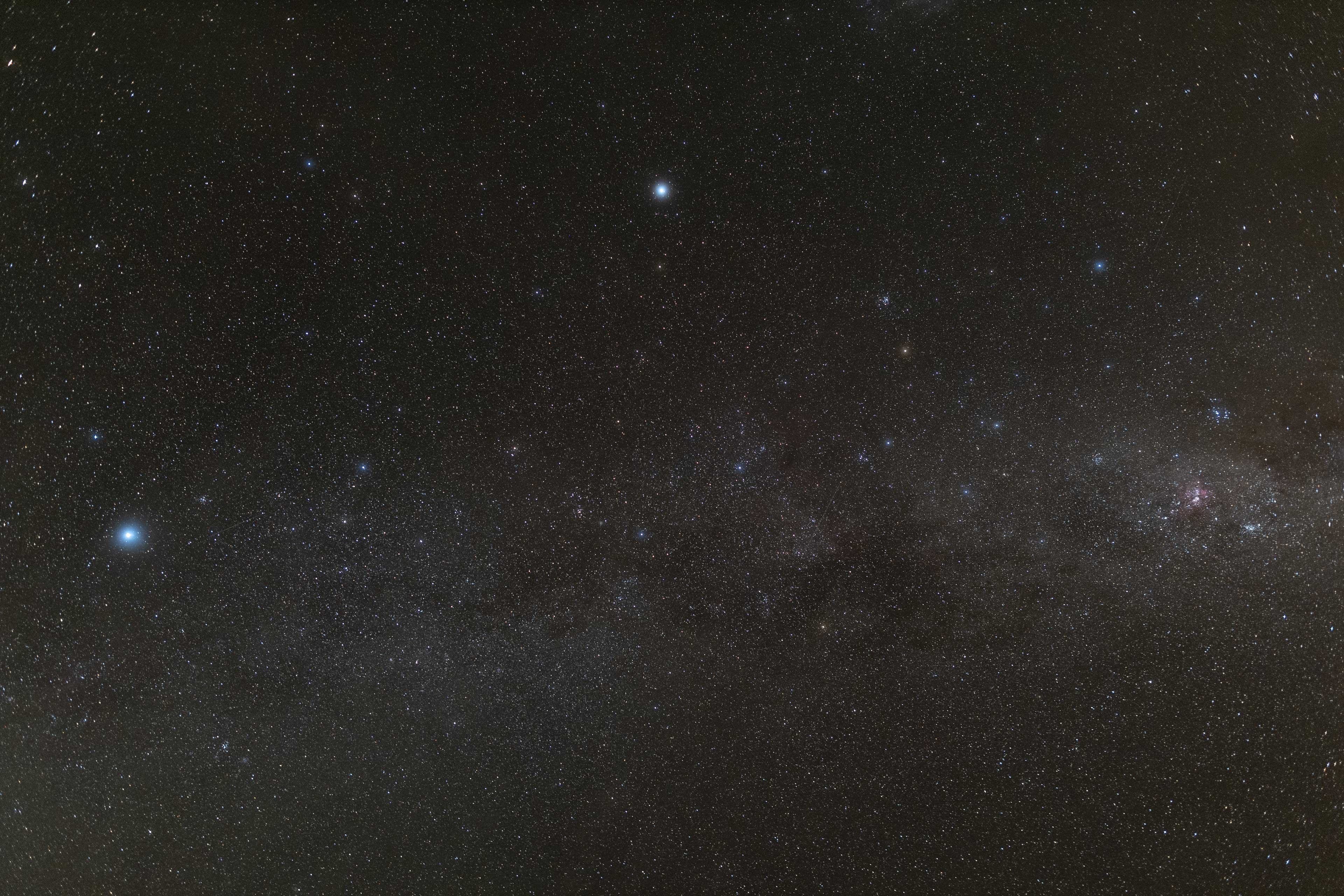
Here’s a photo of Sam and our two telescopes Darth Vader and Princess Leia at Star Safari. The bright star on top of his right hand is Alpha Centauri, our closest neighbouring system. The bright dot above Darth Vader is Omega Centauri, a most exceptional globular cluster of 15,000,000 stars. Photo: Star Safari

Montly Update

🔴 Total Lunar Eclipse – March 14

New Zealand gets a dramatic entrance for this total lunar eclipse! The Moon will rise already fully eclipsed, meaning it will appear deep red on the horizon—even redder than a typical Blood Orange due to atmospheric scattering. From Wellington, the Sun sets at 7:42 PM, with the eclipse at its maximum at 7:58 PM, and the event ending around 11:00 PM. A perfect opportunity to see a lunar eclipse in a way few people in the world will experience! 🌕🔴

☀️ March Equinox – March 20

At 9:02 PM NZDT, the autumn equinox marks the official change of seasons in the Southern Hemisphere, where day and night are approximately equal in length. From this point on, nights will get longer, making it even better for stargazing season! 🌍

🌑 Partial Solar Eclipse – March 29 (But Not for Us!)

There’s a partial solar eclipse happening on March 29, but New Zealand completely misses out. This one is best viewed from northeastern Canada and parts of Europe—so, unless you’re planning a spontaneous holiday, you’ll have to sit this one out. 😅

🌍 Bonus: Global Celebrations

Earth Hour (Saturday, March 22, 8:30–9:30 PM local time) – The annual Earth Hour movement encourages people to switch off lights for one hour to raise awareness about light pollution and climate change. A perfect excuse to step outside and appreciate the true beauty of a dark sky!

📜 Lunar and Planetary Science Conference (March 10–14) – Featuring a Haiku Contest!

One of the most important planetary science conferences in the world, the Lunar and Planetary Science Conference (LPSC) runs from March 10–14 and is open for virtual attendance. This year, they’ve added a Haiku Contest, proving that science and poetry truly belong together! So if you’ve ever wanted to express your love for Mars in 17 syllables, now’s your chance. 🚀✍️ More info here

So, get ready for an unforgettable Moonrise on March 14, celebrate the equinox, and if you need an excuse to turn off the lights, Earth Hour has your back! And if you feel poetic, well… the LPSC Haiku Contest is calling! 🔭✨

February’s Satellite Invasion: Look Up, They’re Everywhere!

If you’ve been out stargazing and thought, “Wow, there are a lot of moving stars tonight!”—nope, that’s just another batch of satellites zooming across the sky. SpaceX is at it again, launching so many Starlink satellites that if they keep this up, we might just get decent reception in rural New Zealand before we get people on Mars 🚀💫 .

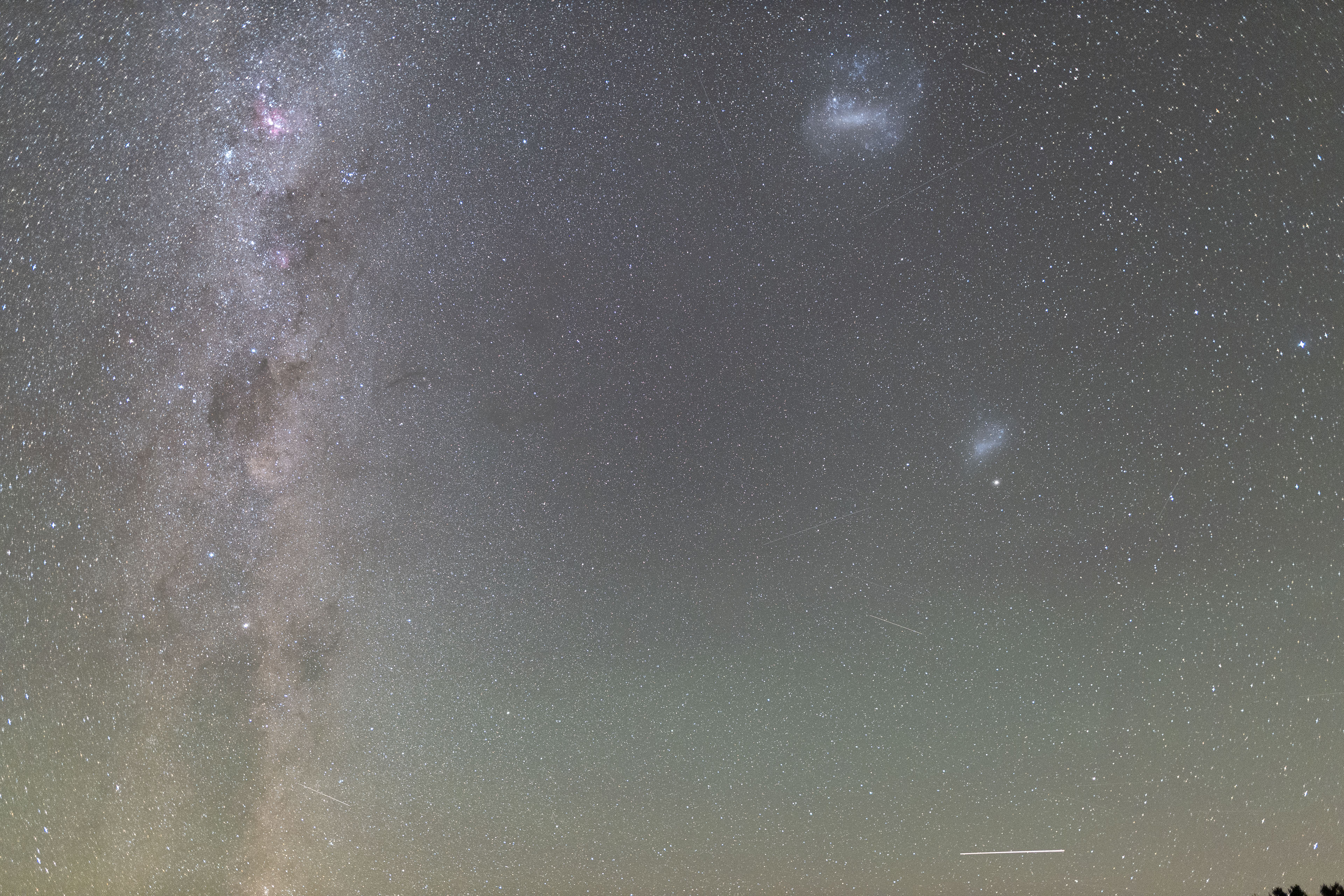
On February 22, a Falcon 9 deployed 21 more Starlink satellites, adding to the already 8,000+ floating around up there. Spotting a satellite train has gone from a rare treat to a “Hey, look, another one!” kind of event. They’re easiest to see just after sunset or before sunrise, when the Sun’s light reflects off them—so if you spot a line of glowing dots parading across the night sky, no, it’s not aliens. It’s just Elon’s space army. We photographed the train on the 22 of February with our meteor camera at Star Safari (photo below). (Spaceflightnow

Meanwhile, Japan decided to join the satellite party by launching Michibiki 6, a fancy GPS satellite that will improve navigation—because apparently, even space needs Google Maps. 📍🚀 (APNews)

If you want to keep track of all these flying space intruders, check out tools like In-The-Sky.org, where you can predict exactly when to wave at the latest batch of orbiting hardware. One thing’s for sure—the night sky is getting busier, and soon, spotting an actual star might become the real challenge! 🔭✨ 

The Planets

March’s Planetary Lineup: Less is More (Literally)

This month’s planet count? Two. (Okay, fine—three if you count Earth, but that one’s kind of a given.) Jupiter and Mars are the only ones gracing our night sky in March. Jupiter, currently hanging out in Taurus, is heading for the horizon, setting earlier each night. One of its four large moons, Callisto, made it to the news last month*. It might have a (yet another) ocean of water underneath! Meanwhile, Mars is in Gemini, playing geometry games—forming a right triangle with Castor and Pollux at the start of the month. But Mars isn’t content just being a third wheel; by April 12th, it’ll perfectly align with the twin stars, creating a supersized version of Orion’s Belt.

Now, let’s talk about Mars’s retrograde motion, aka “Wait, why is that planet going backwards?” Ancient astronomers were so baffled by this weird celestial moonwalk that it led Johannes Kepler to revolutionize astronomy. His famous Laws of Planetary Motion (or “Kepler’s Guide to How Planets Actually Move”) explain it all:

1️⃣ Planets move in ellipses, not perfect circles, with the Sun at one focus—so Mars isn’t confused, just eccentric.

2️⃣ The closer a planet is to the Sun, the faster it moves—meaning Mars speeds up and slows down like a celestial rollercoaster.

3️⃣ There’s a mathematical rule that relates a planet’s orbit time to its distance from the Sun, but unless you’re planning to launch a spacecraft, just trust that it works.

The good news? This is THE year for Mars watchers—it’s staying in our sky for months, so there’s plenty of time to admire its orangey glow. Yay, Mars! 🎉

And in other space gossip: Saturn’s rings are about to disappear! 😱 Well, not literally—but they’re tilting edge-on this year. Unfortunately, we won’t see the effect just yet because Saturn is currently behind the Sun (hiding in shame?). But imagine Saturn without its rings—just a plain old gas giant. Unthinkable.

So, for now, enjoy Mars’s slow dance with the twins, bid farewell to Jupiter, and get ready for a year of amazing Mars observations. 🔭✨

________ *In other exciting news, recent research suggests that Jupiter’s moon, Callisto, is very likely an ocean world. Data from NASA’s Galileo spacecraft indicate that beneath its heavily cratered surface, Callisto may harbour a subsurface salty ocean. This discovery adds another intriguing destination for future exploration in our quest to find extraterrestrial life. (Phys.org)

The Sun

In February 2025, our Sun has been anything but quiet. Here’s a snapshot of recent solar activity and related missions:

Solar Activity Highlights:

Geomagnetic Storms: On February 14 and 15, minor geomagnetic storms (G1 level) were observed due to a coronal hole high-speed stream interacting with Earth’s magnetosphere. (SPWC)

Upcoming Solar Missions:

PUNCH Mission: NASA’s Polarimeter to Unify the Corona and Heliosphere (PUNCH) mission is slated for launch on February 27, 2025. This mission aims to provide unprecedented imaging of the Sun’s corona and solar wind, enhancing our understanding of solar phenomena. 

Solar Orbiter’s Venus Flyby: The ESA/NASA Solar Orbiter spacecraft is preparing for its closest encounter with Venus to date. This maneuver will adjust the spacecraft’s trajectory, enabling it to observe the Sun’s polar regions, which are not visible from Earth. (ESA)

Moon Phases

Full Moon:
January 1, 70 12:00 am
Last Quarter Moon:
January 1, 70 12:00 am
New Moon:
January 1, 70 12:00 am
The First Quarter Moon:
January 1, 70 12:00 am

What to look for in the Milky Way

March: The Sky is Shifting… But Not That Fast!

As autumn settles in the Southern Hemisphere, the Milky Way puts on a spectacular show, arching across the night sky from SSE to NNW—a cosmic river flowing overhead. If this feels familiar, don’t worry; you’re not in a time loop. The sky looks a lot like last month because surprise… the Sun sets earlier!

Over on the northwestern horizon, the Pleiades (Te Tawhiti, the Shining Ones) are packing their celestial bags and preparing for their annual trip to the underworld. They’ll disappear behind the Sun soon, taking a well-earned stellar vacation. Meanwhile, Naos (Zeta Puppis), one of the hottest and most luminous stars visible to the unaided eye, sits directly overhead, flexing its stellar muscles in the zenith.

By midnight, things really get interesting. The centre of the Milky Way rises, dragging Scorpius into view—right as Orion is setting in the northwest. And yes, we’ve all heard the classic Orion vs. Scorpius legend—“They can never be seen together in the sky!” Well… wrong hemisphere! Down here, they’re both chilling in the night sky at the same time, just hanging out on opposite sides.

So once again, the Milky Way stretches across the sky, dividing it into two halves—the Zodiacal constellations on one side and the circumpolar stars on the other. It’s a beautiful, predictable, and slightly rebellious cosmic arrangement. Grab a telescope (or just your eyes), and enjoy the show—March is here!

The stars Sirius and Canopus are visible as two white-blue patches and they make a triangle with Eta Carinae nebula
Sirius, Canopus and Eta Carinae make a triangle in the southern sky

Circumpolar Stars - look to the south

The circumpolar region of the southern skies is the best.

March’s Sky Tour: Crosses, Clusters, and a Side of Stellar Wok

The Southern Cross is doing its usual celestial rotation, hanging around the nine to ten o’clock position near the south celestial pole at the start of the month. It politely points toward Achernar, one of the brightest stars in our sky, sitting on the opposite side.

Higher up, the sky is packed with stellar treasures—the Eta Carina region, the False Cross, and the Diamond Cross are all in prime viewing position. What’s hiding in this cosmic jungle? NGC 2808, a dense globular cluster, and NGC 2442, a galaxy with a dramatic twist—literally, since it looks like it’s been bent out of shape.

Looking between the two Magellanic Clouds in the Reticulum constellation, you’ll find NGC 1313, better known as the Topsy Turvy Galaxy. This starburst galaxy is a mess in the best way possible—if you have a big telescope, you’ll see its chaotic, beautiful spiral arms showing off all that star-forming action.

And, of course, we can’t forget the Tarantula Nebula, which is in perfect viewing position. If nebulae had personalities, this one would be a show-off—an enormous star-forming region bursting with energy and easily visible even with binoculars.

Now, if you turn to the other side of the Milky Way, you’ll find Omega Centauri, sitting right at the bottom of the Wok (yes, there’s a Wok in the sky—it’s an asterism made of bright stars in Centaurus). And what a sight Omega Centauri is! While visible to the unaided eye and stunning through binoculars, this globular cluster truly shines through a telescope, revealing a mind-blowing 15 million stars packed together like a stellar New York – a city that never sleeps.

So, whether you’re here for the crosses, galaxies, or cosmic cookware, March’s Sky has plenty to explore—and best of all, no reservations are required!

Globe at Night this month features

Crux (The Southern Cross)

Space Missions & Cool Science

Reference Material

These guides don’t change each month — they’re your evergreen reference library. Perfect for beginners discovering the NZ night sky for the first time, or regulars who want a quick refresher.

Did you know that the Milky Way is always in the sky?

Whether high overhead or hugging the horizon or anything in between, the Milky Way is always there. The reason we can’t always see it is … LIGHT POLLUTION! Even though the light pollution in question sometimes comes from our lovely Moon*.

The part of the Milky Way that will always be in our southern sky is the beautiful region of Vela, Carina and Puppis, as well as the Southern Cross. These stars are circumpolar.

By definition, our galaxy is the sum of about 100 billion stars (NASA; ESA). Our Solar System sits about two-thirds of the way from its center, so we see this vast collection of stars as a glowing band across the sky crossed by long dark lines. Some of these stars are bright enough to resolve (stargazer slang for ‘distinguish’) with the unaided eye, while others reveal their detail through binoculars or telescopes.

______

*Yet, even under a full Moon, you can still glimpse the Milky Way from Star Safari—faint, but definitely there!

What is the Circumpolar Region?

The Circumpolar Region is that part of the sky we always see from our latitude here in Aotearoa. It contains some of the most spectacular objects visible in the entire sky. 

The Milky Way intersects the circumpolar region in the Carina-Crux region.  

Famous New Zealand asterisms in there are: The Fish in the Frying Pan, The Diamond Cross, and the False Cross. 

In addition, the bright stars Canopus and Achernar are also circumpolar from New Zealand, as are the Magellanic Clouds, our pet galaxies. 

Stars in the circumpolar region neither rise nor set; they continuously circle the celestial pole, completing one full rotation in 23 hours and 56 minutes. This means that at the same hour each night, they appear slightly shifted compared to the previous night, gradually changing their position over the course of the year.

Learn about the Zodiacal Band

As the Earth and the other planets in our solar system orbit around the Sun, they do so almost in the same plane – this is called the ecliptic. From our point of view on Earth, this looks like a band of about 8 degrees in the sky, which is smaller than the width of your fist held at arm’s length.  The stars that are visible behind the path of the planets are the Zodiacal Constellations, they form the Zodiacal Band.

You are not who you think you are ...
This is the Zodiacal band, an excellent drawing by Eugene Georgiades. For one thousand years, when people stopped taking precision into account, the zodiacal constellations have shifted. Yes, we are once again not what we think we are. Here is an excellent site with more details about your real star sign.

When and where can we see the planets

The Inner Planets

Mercury and Venus, being close to the Sun, are only visible just after sunset or just before sunrise—never in the middle of the night. Their elongation, distance from the Sun, is always less than half the sky.

The Outer Planets

Mars, Jupiter, Saturn, Uranus, and Neptune can appear at any time of the night, depending on their position in their orbits.

Uranus and Neptune are too dim to be seen with the unaided eye, requiring binoculars or a telescope. In fact, their faintness kept them hidden until they were identified as planets—Uranus on 13 March 1781 and Neptune on 23 September 1846.

And a bit more about planetary alignments

Media often sensationalizes these events, but in reality, they are regular occurrences without significant impact**. The planets in our Solar System orbit the Sun in roughly the same plane, known as the ecliptic, with orbital inclinations typically within a few degrees of each other. For instance, Mercury has the largest inclination at about 7 degrees. Given this arrangement, alignments of planets are natural and frequent phenomena and most times rather than not we will see the planets in an arch across the sky. 

Not all planets are visible at one given time, always: some are in the morning sky, some are in the evening sky and some are hiding behind the Sun.

____

**Except for the famous planetary alignment that led to the launch the Voyagers.

The Voyager mission took advantage of a rare planetary alignment in the late 1970s and 1980s, enabling a four-planet tour—Jupiter, Saturn, Uranus, and Neptune—with minimal fuel and time. This alignment, occurring once every 175 years, allowed the spacecraft to use gravity assists instead of large onboard propulsion (NASA).

When to best see satellites and other 'UFO's

The best time to see satellites is just after sunset or before sunrise. Why? Because of the angle at which light falls onto them. 

Meteor Camera
Meteor Camera output

UFOs: Unidentified? Not for Long!

Every stargazing night, someone inevitably spots a mysterious moving light and whispers, “What was the weirdest thing you guys have seen?” And even with more than 12,000+ satellites orbiting above us, the answer is usually, “No, that’s just Elon Musk’s space WiFi.”

Satellites Orbits at Star Safari, photo Sam Leske, 2025

But let’s not ruin all the fun—because historically, UFO sightings have ranged from military test flights to overenthusiastic birds reflecting city lights. The real trick is knowing what’s actually up there:

🛰 Satellites – They glide steadily across the sky, sometimes in long trains (looking at you, Starlink).

🔥 Space junk re-entry – They can make for a good light show, but they look more like a match catching on fire rather than an alien invasion.

☄️ Meteors – Quick, bright streaks that don’t hover, so if it’s zooming and gone in a flash, you’re probably safe from abduction.

🛸 Actual UFO? – Well… statistically unlikely, but if they do land in NZ, make sure to ask them “So… what did you get up to in the weekend?” That should send them straight back to their spacecraft.

Be a citizen scientist and contribute to Globe at Night

Is stargazing a hobby? Turn your passion into science!

The best way to learn the night sky is to observe it—and you can also contribute to science! Globe at Night is a citizen science project where you count stars in specific constellations to help track light pollution worldwide.

Also checkout our Stargazing Guide

The Night Sky Monthly series from Milky-Way.Kiwi shares what’s above Aotearoa each month — the stars, the planets, and the odd deep-sky treasure. It’s written from the Wairarapa Dark Sky Reserve, which Lonely Planet recently called one of the world’s top stargazing experiences.

Our upcoming Events

Stargaze with us from Wairarapa