Look up and see the stars

in October

A Night Sky Guide for Aotearoa

Table of Contents

October 2025 brings us Saturn, the planet that single-handedly saves this month from being cosmically dull. The rest of the sky? Mostly empty of easy deep-sky treasures unless you’ve got skills, patience, and, of course, time for stargazing. We have at least two sixteen-inch telescopes and the Wairarapa Dark Sky Reserve to look at the fabulous southern hemisphere sky. So here’s what’s on for the month:

It seems humans noticed this celestial gap and decided to fill it with… events. Lots of them. Maybe too many. In the first ten days alone, we’ve got the 100 Hours of Astronomy, World Space Week, International Observe the Moon Night, the IAC, and even the mighty NZ Aerospace Conference. It’s as if the Universe said, “Here, have Saturn,” and humanity replied, “Hold my coffee, I’ve got a schedule.” And if we can’t make it to all of them, at least we get the best work out for our decision-making muscles.

When to see stuff:

The Moon crashes the party on the 7th of October, right in the middle of World Space Week. Unless you’re into Moongazing or Moon Gardens (we have both at Star Safari, by the way), prepare for a luminous takeover.

Luckily, our telescopes at Star Safari are absolute beasts. Even with a Full Moon blasting light like a paparazzi flash, you’ll still need to keep your phones in your pockets because we’ll still show you heaps of cool stuff. They can handle everything. But there is something to be said about having so much light in the sky at night:

  • Want to learn the constellations? Full Moon is your friend.
  • Hunting deep-sky objects? Wait for New Moon (and maybe bring snacks).
  • Never been stargazing before? Any night is perfect.

So join us in the Wairarapa Dark Sky Reserve. There’s a growing buzz about Wairarapa — and for good reason. Beneath the officially certified Wairarapa Dark Sky Reserve, the stars stretch across some of the clearest, darkest skies on Earth. From the rolling hills to the Milky Way above, this region is fast becoming known as one of the world’s premier stargazing destinations.

Rumour has it there’s a comet on the way next month. We’ll see if it lives up to the hype. Oh, and Saturn’s rings will go all minimalist for a few days — it’s called a “ring plane crossing”, which is so cool because we can finally see how squashed Saturn is.
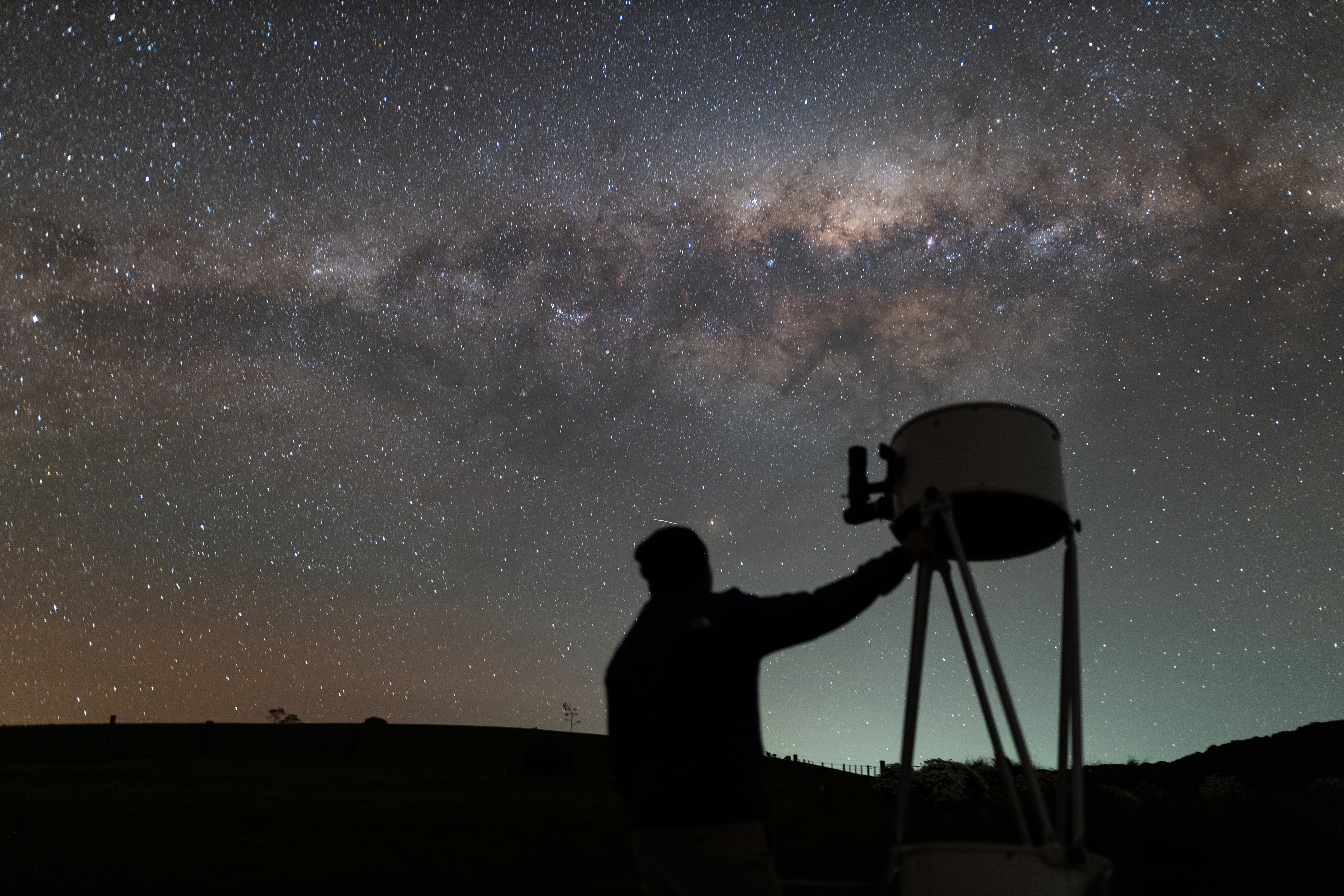
Alpha & Omega.

Here’s a photo of Sam and our two telescopes Darth Vader and Princess Leia at Star Safari. The bright star on top of his right hand is Alpha Centauri, our closest neighbouring system. The bright dot above Darth Vader is Omega Centauri, a most exceptional globular cluster of 15,000,000 stars. Photo: Star Safari

Montly Update

3-5 October – 100 Hours of Astronomy – Milky-Way.Kiwi (that’s us) got to be a National Node for this event 4th of October – International Observe the Moon Night is an annual event 4 – 10 of October – World Space Week – this is an international event that celebrates the impact that space technologies have on our lifes here on Earth

Meteor showers:

NOT VISIBLE – the Draconid Meteor Shower is in a constellation called Draco, which is not visible from New Zealand You must wake up early for the Orionid Meteor Shower, as Orion is in the sky after midnight around October 22nd when it is at its peak, however the shower starts around 2nd of October and goes all the way to 7 November.

Comets

Comet C/2025 A6 (Lemmon) at its closest distance to Earth on Oct. 22, potentially visible with your eyes, but visible from New Zealand at the end of the month after sunset. It will be in the northwestern part of the sky, going through Canes Venatici, Bootes and Serpent (underneath the Milky Way) and visible in the evening sky after October 30th.
Expedition 73 is currently on the International Space Station until December. Axiom’s Astronaut Michael López-Alegría visited New Zealand during World Space Week to attend the Aerospace Conference in Christchurch. We interviewed him from the Air Force Museum – watch this space. Tiangong—China’s three-module Space Station—saw Astronauts Chen Z. and Wang J. made a spacewalk on September 25 from the Wentian module.

The Planets

  • Saturn was at Opposition on the 21st of September (Opposite the Sun), which means this month is in a really great place to observe. It will be high in the northern sky after sunset.
  • Neptune is very close to Saturn, but at magnitude 7.8, you really need a telescope to observe it.
  • Mercury is in the western sky, moving up throughout the month and getting very close to the star Dschubba that makes what we call the eyes of the Scorpion on the 1st of November. Then it will start moving back down closer to the Sun. Mercury is very bright, at -0.2 magnitude.
  • Mercury and Mars will be very close together from 17 to 22 October. Mars is now fainter than Mercury, at 1.5 magnitude, starting at about a fist (held at arm’s length) above the horizon, which is 10 degrees high in mid-October and going to about 15 degrees in the next two weeks.

After midnight

  • Jupiter is in Gemini this month. Look for it to the right of the bright stars Pollux and Castor, which will be just below it.
  • Venus is the bright object low in the morning sky, but it is visually very close to the Sun.

The Sun

The only star we can see during the day, the Sun, is 150 million kilometres away. Here is another great video about the Sun “From agriculture to economics, the Sun touches all parts of our lives, especially with the sunlight that allows crops to grow. This webinar looks at sunlight through the year and how it changes.” Learn more at NASA Heliophysics Education The Sun is now crossing through the constellation of Virgo, which means that if we could look and see the Sun and the stars in the sky in daylight, the Sun would appear to cross the region of the sky marked as Virgo. Fun fact, the Sun has the same apparent diameter as the Moon, which is half of a degree which is half the width of your pinky held at arm’s length. NEVER LOOK DIRECTLY AT THE SUN.

Moon Phases

Full Moon:
October 7, 25 4:48 pm
Last Quarter Moon:
October 14, 25 7:13 am
New Moon:
October 22, 25 1:25 am
The First Quarter Moon:
October 30, 25 5:20 am

What to look for in the Milky Way

In October, after sunset, the Milky Way’s centre hangs from the sky in the west. For Māori, this is now known as Te Ika Roa, the big fish. The fishhook of Maui (the name for Scorpius this time of the year) is caught in it, and together, they sink towards the western horizon throughout the night. (The Navigators, 2020). In the morning sky, Te Waka a Rangi’s Taramainuku collects the souls of those who passed away that day, keeping them in the waka until the next Matariki (Māori New Year)(Te Aka, 2025). What this means is that in October, the centre of the Milky Way lies low on the horizon and is visible in the evening, looking towards Scorpius and Sagittarius—the Milky Way’s edges, where Orion is, become visible just after Scorpius has set.

Circumpolar Stars - look to the south

South Circumpolar Region in September-October from New Zealand Wairarapa. Canon Ra, 13 sec., ISO 4000
The Small Magellanic Cloud is now in a great position to observe. 47 Tucanae is a fantastic object to look at in a telescope, the second-largest globular cluster in the sky, with two million stars. Some cool deep-sky objects: NGC 1261 is a great glob to try and see in Horologium (mag 8.3), NGC 6752 Glob in Pavo, and NGC 6744 Galaxy in Pavo (8.3 mag) (if everything else fails, look at Saturn 😹).

Globe at Night this month features

Grus

Grus is a beautiful constellation that rotates around the South Celestial Circle. It is made of a line of double stars crossed by a shorter one, hence its resemblance to a bird.

Space Missions & Cool Science

Reference Material

These guides don’t change each month — they’re your evergreen reference library. Perfect for beginners discovering the NZ night sky for the first time, or regulars who want a quick refresher.

Did you know that the Milky Way is always in the sky?

Whether high overhead or hugging the horizon or anything in between, the Milky Way is always there. The reason we can’t always see it is … LIGHT POLLUTION! Even though the light pollution in question sometimes comes from our lovely Moon*.

The part of the Milky Way that will always be in our southern sky is the beautiful region of Vela, Carina and Puppis, as well as the Southern Cross. These stars are circumpolar.

By definition, our galaxy is the sum of about 100 billion stars (NASA; ESA). Our Solar System sits about two-thirds of the way from its center, so we see this vast collection of stars as a glowing band across the sky crossed by long dark lines. Some of these stars are bright enough to resolve (stargazer slang for ‘distinguish’) with the unaided eye, while others reveal their detail through binoculars or telescopes.

______

*Yet, even under a full Moon, you can still glimpse the Milky Way from Star Safari—faint, but definitely there!

What is the Circumpolar Region?

The Circumpolar Region is that part of the sky we always see from our latitude here in Aotearoa. It contains some of the most spectacular objects visible in the entire sky. 

The Milky Way intersects the circumpolar region in the Carina-Crux region.  

Famous New Zealand asterisms in there are: The Fish in the Frying Pan, The Diamond Cross, and the False Cross. 

In addition, the bright stars Canopus and Achernar are also circumpolar from New Zealand, as are the Magellanic Clouds, our pet galaxies. 

Stars in the circumpolar region neither rise nor set; they continuously circle the celestial pole, completing one full rotation in 23 hours and 56 minutes. This means that at the same hour each night, they appear slightly shifted compared to the previous night, gradually changing their position over the course of the year.

Learn about the Zodiacal Band

As the Earth and the other planets in our solar system orbit around the Sun, they do so almost in the same plane – this is called the ecliptic. From our point of view on Earth, this looks like a band of about 8 degrees in the sky, which is smaller than the width of your fist held at arm’s length.  The stars that are visible behind the path of the planets are the Zodiacal Constellations, they form the Zodiacal Band.

You are not who you think you are ...
This is the Zodiacal band, an excellent drawing by Eugene Georgiades. For one thousand years, when people stopped taking precision into account, the zodiacal constellations have shifted. Yes, we are once again not what we think we are. Here is an excellent site with more details about your real star sign.

When and where can we see the planets

The Inner Planets

Mercury and Venus, being close to the Sun, are only visible just after sunset or just before sunrise—never in the middle of the night. Their elongation, distance from the Sun, is always less than half the sky.

The Outer Planets

Mars, Jupiter, Saturn, Uranus, and Neptune can appear at any time of the night, depending on their position in their orbits.

Uranus and Neptune are too dim to be seen with the unaided eye, requiring binoculars or a telescope. In fact, their faintness kept them hidden until they were identified as planets—Uranus on 13 March 1781 and Neptune on 23 September 1846.

And a bit more about planetary alignments

Media often sensationalizes these events, but in reality, they are regular occurrences without significant impact**. The planets in our Solar System orbit the Sun in roughly the same plane, known as the ecliptic, with orbital inclinations typically within a few degrees of each other. For instance, Mercury has the largest inclination at about 7 degrees. Given this arrangement, alignments of planets are natural and frequent phenomena and most times rather than not we will see the planets in an arch across the sky. 

Not all planets are visible at one given time, always: some are in the morning sky, some are in the evening sky and some are hiding behind the Sun.

____

**Except for the famous planetary alignment that led to the launch the Voyagers.

The Voyager mission took advantage of a rare planetary alignment in the late 1970s and 1980s, enabling a four-planet tour—Jupiter, Saturn, Uranus, and Neptune—with minimal fuel and time. This alignment, occurring once every 175 years, allowed the spacecraft to use gravity assists instead of large onboard propulsion (NASA).

When to best see satellites and other 'UFO's

The best time to see satellites is just after sunset or before sunrise. Why? Because of the angle at which light falls onto them. 

Meteor Camera
Meteor Camera output

UFOs: Unidentified? Not for Long!

Every stargazing night, someone inevitably spots a mysterious moving light and whispers, “What was the weirdest thing you guys have seen?” And even with more than 12,000+ satellites orbiting above us, the answer is usually, “No, that’s just Elon Musk’s space WiFi.”

Satellites Orbits at Star Safari, photo Sam Leske, 2025

But let’s not ruin all the fun—because historically, UFO sightings have ranged from military test flights to overenthusiastic birds reflecting city lights. The real trick is knowing what’s actually up there:

🛰 Satellites – They glide steadily across the sky, sometimes in long trains (looking at you, Starlink).

🔥 Space junk re-entry – They can make for a good light show, but they look more like a match catching on fire rather than an alien invasion.

☄️ Meteors – Quick, bright streaks that don’t hover, so if it’s zooming and gone in a flash, you’re probably safe from abduction.

🛸 Actual UFO? – Well… statistically unlikely, but if they do land in NZ, make sure to ask them “So… what did you get up to in the weekend?” That should send them straight back to their spacecraft.

Be a citizen scientist and contribute to Globe at Night

Is stargazing a hobby? Turn your passion into science!

The best way to learn the night sky is to observe it—and you can also contribute to science! Globe at Night is a citizen science project where you count stars in specific constellations to help track light pollution worldwide.

Also checkout our Stargazing Guide

The Night Sky Monthly series from Milky-Way.Kiwi shares what’s above Aotearoa each month — the stars, the planets, and the odd deep-sky treasure. It’s written from the Wairarapa Dark Sky Reserve, which Lonely Planet recently called one of the world’s top stargazing experiences.

Our upcoming Events

Stargaze with us from Wairarapa