Look up and see the stars

In January

A Night Sky Guide for Aotearoa

Table of Contents

Still writing last year’s date on your meeting notes? Blame Janus Bifrons, the Roman god who looks both forward and back — patron of both the past and the future and namesake for January. Or the other way around, since it’s already happened and Janus came first. He’d probably approve of astronomy: it’s the only hobby where staring into the past is looking into the future.

Farmgazing continues in January: the Dog, the Cow, and the Sheep are all still there, having returned to the night sky after slipping out from behind the Sun’s glare in December. The sky always feels fuller in January, even though the Milky Way leans quietly along the southern horizon. It’s an illusion – when you face north, you’re looking toward the outer edge of our galaxy — the peaceful suburbs of the cosmos. Suitable for reflection, mild existential crises, or simply wondering why the stars look so relaxed this time of year – they are actually on holiday time. And from the Frypan to the Pot, gastronomy is the secret password in the country with the world’s tastiest food.
Alpha & Omega.

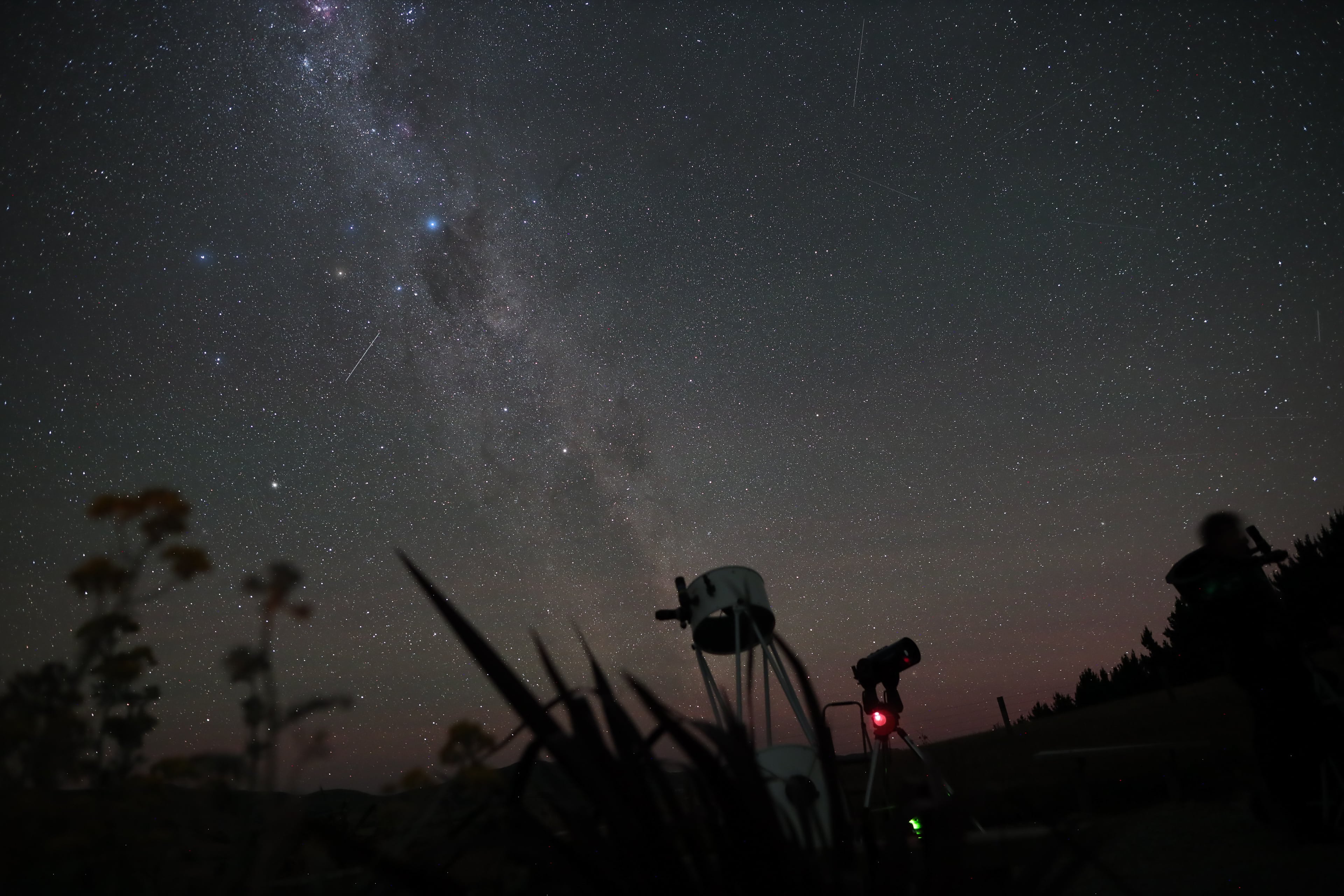
Here’s a photo of Sam and our two telescopes Darth Vader and Princess Leia at Star Safari. The bright star on top of his right hand is Alpha Centauri, our closest neighbouring system. The bright dot above Darth Vader is Omega Centauri, a most exceptional globular cluster of 15,000,000 stars. Photo: Star Safari

Montly Update

January: busy on Earth, busy in space, and the Moon is busy trying to outshine the lot of them.

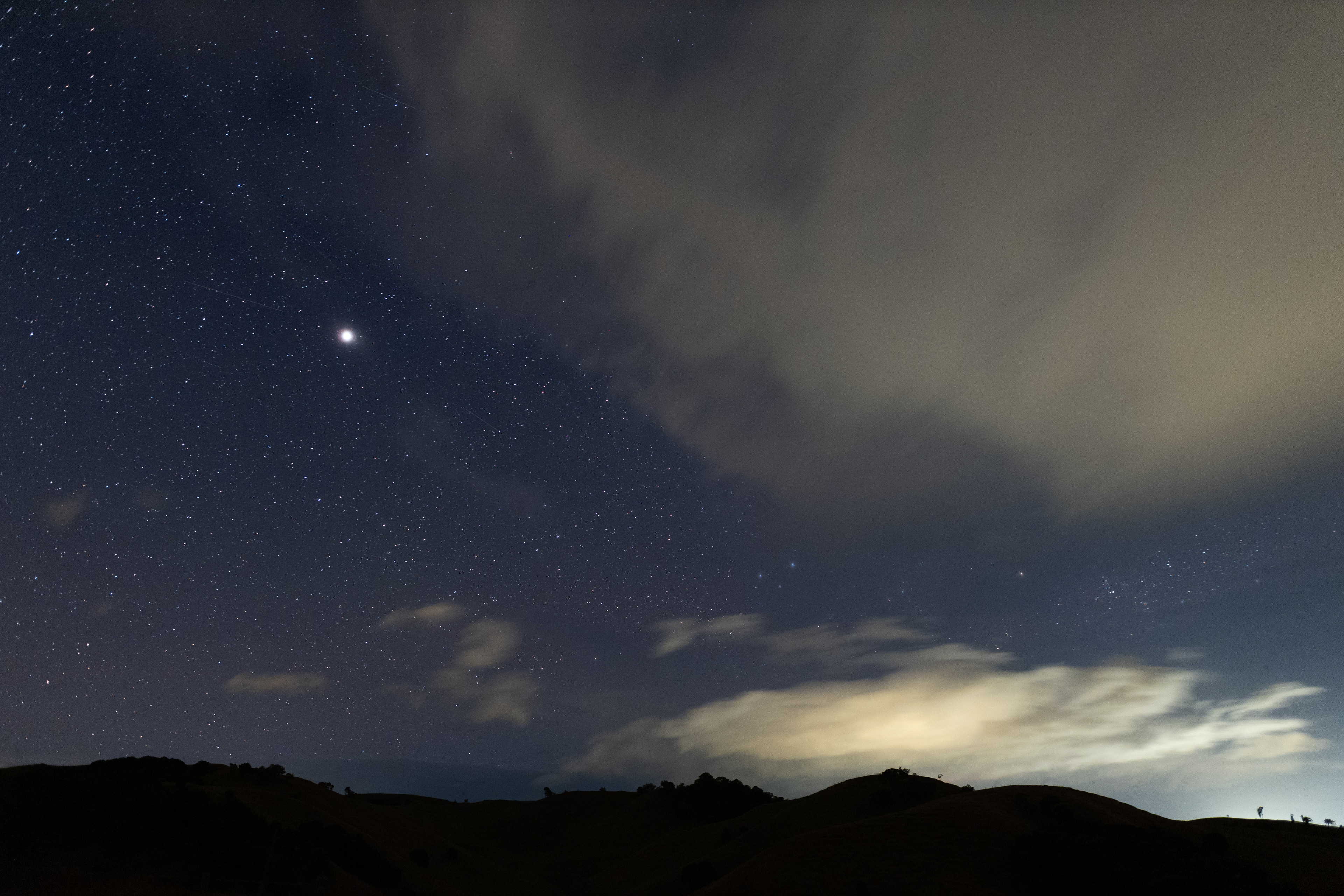
January kicks off with a Supermoon on the 3rd, because of course it does. Jupiter launches a counteroffensive, reaching opposition on the 10th, reflecting back to us on Earth all the light the Sun can give, and trying very hard to remind everyone who the real gas giant is.

Oh, and the Quadrantids (that’s a meteor shower) also occur this month, but don’t worry — the Full Moon has kindly agreed to light-pollute the entire thing, so you’re unlikely to miss much – not that you would miss much anyway, meteor showers in the southern hemisphere are best recorded with the meteor camera. Luckily, we have one and check out how cool it is to turn these meteors around in the graph! (Click and drag on the map).

Things calm down again by the New Moon on the 19th, followed by one last dramatic flourish on the 28th, when the Moon almost eclipses the Pleiades. Almost. Classic Moon: always just slightly in the way.

The Planets

In the evening sky, Jupiter is high, at opposition on the 10th, Saturn is low (but still going strong in the west), and  Mars, Mercury, and Venus are nowhere to be seen. And so is Pluto if you care.  

The Sun

In January, Earth reaches perihelion — the point in its orbit when it’s closest to the Sun. And it happens right in the middle of our summer!

Perihelion occurs on 4 January 2026 at 5:16 AM, when Earth sits about 147 million kilometres from the Sun (147,099,894,000 metres, if you enjoy precision).

Not only are we closest to the Sun at this time of year, but from the Southern Hemisphere, Earth’s axis is tilted toward the Sun, giving us long days, short nights, and at last, we get warm evenings, just right for stargazing.

Moon Phases

Full Moon:
January 3, 26 11:03 pm
Last Quarter Moon:
January 11, 26 4:48 am
New Moon:
January 19, 26 8:52 am
The First Quarter Moon:
January 26, 26 5:47 pm

What to look for in the Milky Way

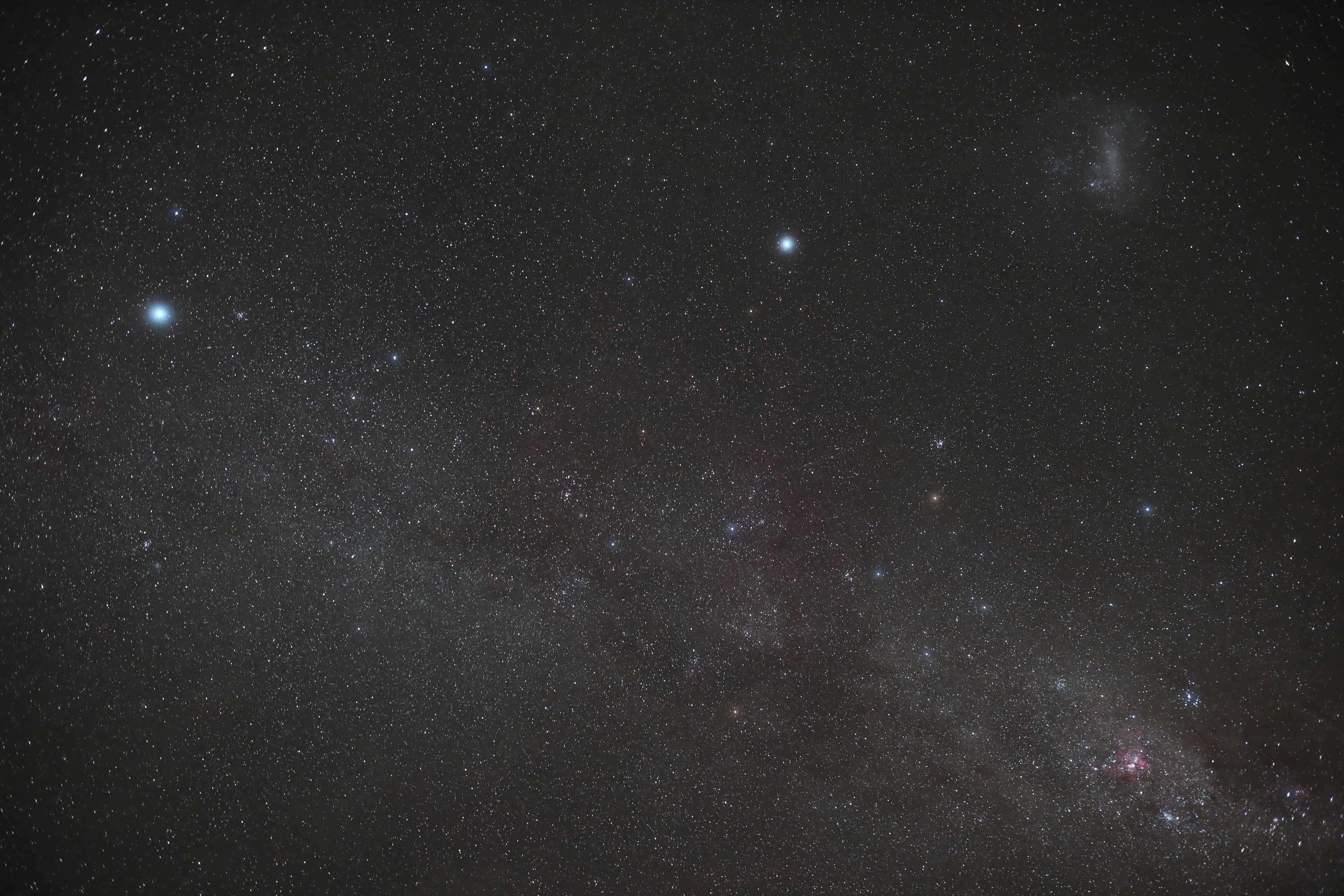
You’re in the Southern Hemisphere, and if you’ve never been here before, the Southern Cross is probably the first thing you want to see! You’re in luck, the Southern Cross now slowly climbs into view, and you can see the fantastic asterism of the Fish in the Frying Pan – photo below. Image taken with a Canon Ra, 15 sec at f 2.0, ISO 4,000 and a Sigma Art 24mm lens. The photo is straight out of the camera – unprocessed—location – Star Safari Observatory, 41 lat S, NZ.

Circumpolar Stars - look to the south

Photo of the Milky Way as seen from Star Safari observatory in Wairarapa, near Martinborough
The stars Sirius, Canopus and Eta Carinae are visible as well as the Milky Way
Draw a line from the brightest star in the sky (the leftmost star in the photo, or Sirius) to the second brightest – Canopus, and extend that by half the distance, you’ll find the Large Magellanic Cloud, a galaxy so large that you can easily mistake it for a real cloud. In the circumpolar region, the Large Magellanic Cloud is in an excellent position to observe; you can see the famous Tarantula Nebula. Image taken with a Canon Ra, 16 sec at f 2.0, ISO 4,000 and a Sigma Art 24mm lens. The photo is straight out of the camera – unprocessed. Location – Star Safari Observatory, 41 lat S, NZ.

Globe at Night this month features

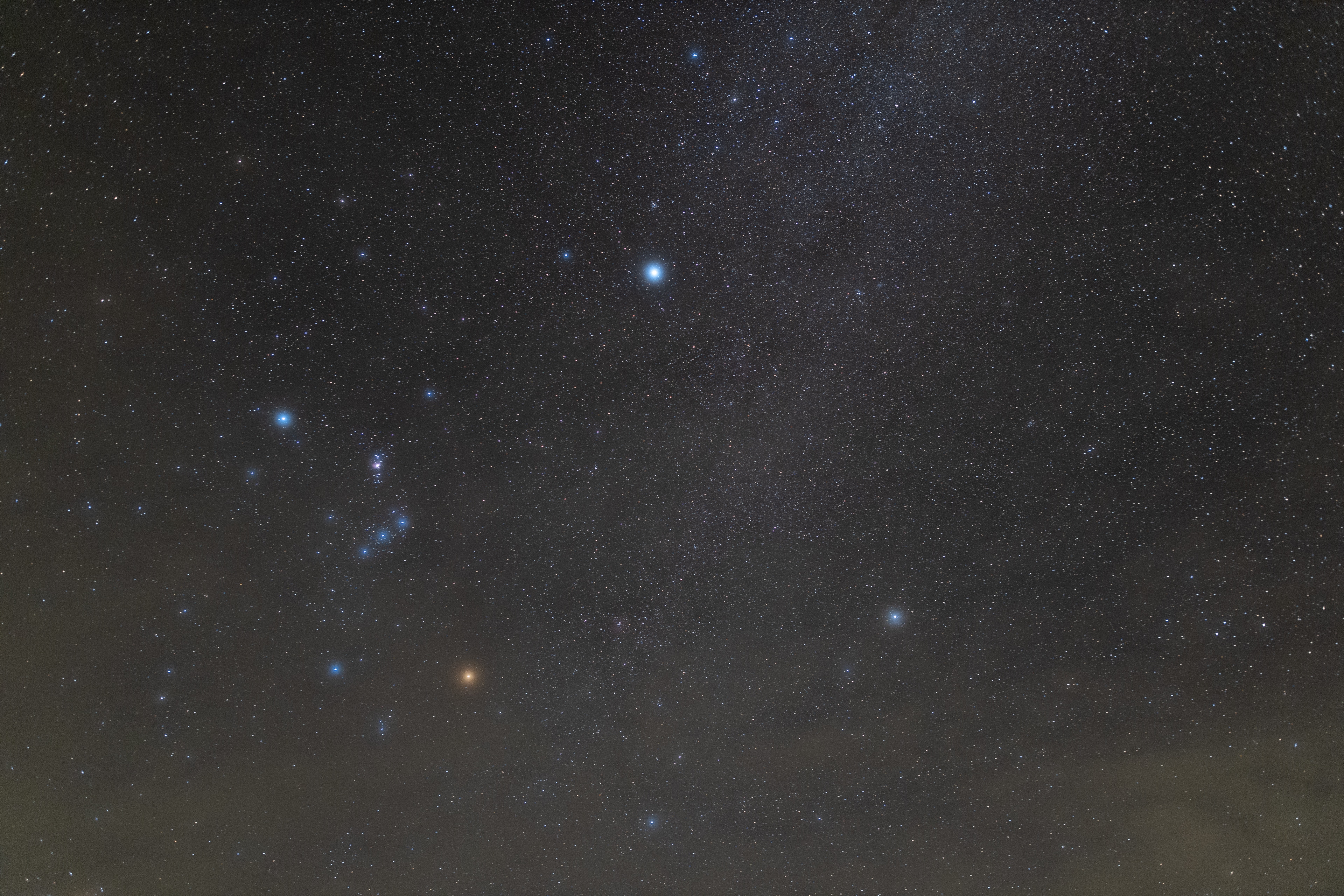
Orion and Canis Major

Orion

Space Missions & Cool Science

Meanwhile, back on Earth, Blue Origin’s ‘Blue Moon Mark 1’ (which we heard details about at the New Zealand Aerospace Conference in November) is scheduled to test a NASA payload — part of NASA’s Commercial Lunar Payload Services program. Over in India, ISRO is planning the maiden flight of its human-rated LVM3 (Launch Vehicle Mark 3), a crucial step in its Gaganyaan human spaceflight programme. And if you are a SpaceCom fan, it’s The Space Congress Show: Orlando, 28–30 January 2026.

Reference Material

These guides don’t change each month — they’re your evergreen reference library. Perfect for beginners discovering the NZ night sky for the first time, or regulars who want a quick refresher.

Did you know that the Milky Way is always in the sky?

Whether high overhead or hugging the horizon or anything in between, the Milky Way is always there. The reason we can’t always see it is … LIGHT POLLUTION! Even though the light pollution in question sometimes comes from our lovely Moon*.

The part of the Milky Way that will always be in our southern sky is the beautiful region of Vela, Carina and Puppis, as well as the Southern Cross. These stars are circumpolar.

By definition, our galaxy is the sum of about 100 billion stars (NASA; ESA). Our Solar System sits about two-thirds of the way from its center, so we see this vast collection of stars as a glowing band across the sky crossed by long dark lines. Some of these stars are bright enough to resolve (stargazer slang for ‘distinguish’) with the unaided eye, while others reveal their detail through binoculars or telescopes.

______

*Yet, even under a full Moon, you can still glimpse the Milky Way from Star Safari—faint, but definitely there!

What is the Circumpolar Region?

The Circumpolar Region is that part of the sky we always see from our latitude here in Aotearoa. It contains some of the most spectacular objects visible in the entire sky. 

The Milky Way intersects the circumpolar region in the Carina-Crux region.  

Famous New Zealand asterisms in there are: The Fish in the Frying Pan, The Diamond Cross, and the False Cross. 

In addition, the bright stars Canopus and Achernar are also circumpolar from New Zealand, as are the Magellanic Clouds, our pet galaxies. 

Stars in the circumpolar region neither rise nor set; they continuously circle the celestial pole, completing one full rotation in 23 hours and 56 minutes. This means that at the same hour each night, they appear slightly shifted compared to the previous night, gradually changing their position over the course of the year.

Learn about the Zodiacal Band

As the Earth and the other planets in our solar system orbit around the Sun, they do so almost in the same plane – this is called the ecliptic. From our point of view on Earth, this looks like a band of about 8 degrees in the sky, which is smaller than the width of your fist held at arm’s length.  The stars that are visible behind the path of the planets are the Zodiacal Constellations, they form the Zodiacal Band.

You are not who you think you are ...
This is the Zodiacal band, an excellent drawing by Eugene Georgiades. For one thousand years, when people stopped taking precision into account, the zodiacal constellations have shifted. Yes, we are once again not what we think we are. Here is an excellent site with more details about your real star sign.

When and where can we see the planets

The Inner Planets

Mercury and Venus, being close to the Sun, are only visible just after sunset or just before sunrise—never in the middle of the night. Their elongation, distance from the Sun, is always less than half the sky.

The Outer Planets

Mars, Jupiter, Saturn, Uranus, and Neptune can appear at any time of the night, depending on their position in their orbits.

Uranus and Neptune are too dim to be seen with the unaided eye, requiring binoculars or a telescope. In fact, their faintness kept them hidden until they were identified as planets—Uranus on 13 March 1781 and Neptune on 23 September 1846.

And a bit more about planetary alignments

Media often sensationalizes these events, but in reality, they are regular occurrences without significant impact**. The planets in our Solar System orbit the Sun in roughly the same plane, known as the ecliptic, with orbital inclinations typically within a few degrees of each other. For instance, Mercury has the largest inclination at about 7 degrees. Given this arrangement, alignments of planets are natural and frequent phenomena and most times rather than not we will see the planets in an arch across the sky. 

Not all planets are visible at one given time, always: some are in the morning sky, some are in the evening sky and some are hiding behind the Sun.

____

**Except for the famous planetary alignment that led to the launch the Voyagers.

The Voyager mission took advantage of a rare planetary alignment in the late 1970s and 1980s, enabling a four-planet tour—Jupiter, Saturn, Uranus, and Neptune—with minimal fuel and time. This alignment, occurring once every 175 years, allowed the spacecraft to use gravity assists instead of large onboard propulsion (NASA).

When to best see satellites and other 'UFO's

The best time to see satellites is just after sunset or before sunrise. Why? Because of the angle at which light falls onto them. 

Meteor Camera
Meteor Camera output

UFOs: Unidentified? Not for Long!

Every stargazing night, someone inevitably spots a mysterious moving light and whispers, “What was the weirdest thing you guys have seen?” And even with more than 12,000+ satellites orbiting above us, the answer is usually, “No, that’s just Elon Musk’s space WiFi.”

Satellites Orbits at Star Safari, photo Sam Leske, 2025

But let’s not ruin all the fun—because historically, UFO sightings have ranged from military test flights to overenthusiastic birds reflecting city lights. The real trick is knowing what’s actually up there:

🛰 Satellites – They glide steadily across the sky, sometimes in long trains (looking at you, Starlink).

🔥 Space junk re-entry – They can make for a good light show, but they look more like a match catching on fire rather than an alien invasion.

☄️ Meteors – Quick, bright streaks that don’t hover, so if it’s zooming and gone in a flash, you’re probably safe from abduction.

🛸 Actual UFO? – Well… statistically unlikely, but if they do land in NZ, make sure to ask them “So… what did you get up to in the weekend?” That should send them straight back to their spacecraft.

Be a citizen scientist and contribute to Globe at Night

Is stargazing a hobby? Turn your passion into science!

The best way to learn the night sky is to observe it—and you can also contribute to science! Globe at Night is a citizen science project where you count stars in specific constellations to help track light pollution worldwide.

Also checkout our Stargazing Guide

The Night Sky Monthly series from Milky-Way.Kiwi shares what’s above Aotearoa each month — the stars, the planets, and the odd deep-sky treasure. It’s written from the Wairarapa Dark Sky Reserve, which Lonely Planet recently called one of the world’s top stargazing experiences.

Our upcoming Events

Stargaze with us from Wairarapa